
Criminal Court Cases in Marshall County
The Marshall County Circuit Court Clerk is the central custodian for Circuit, Criminal, and General Sessions files. The Circuit Court exercises criminal jurisdiction in Tennessee's 17th Judicial District. General Sessions handles preliminary felony work and misdemeanors within its jurisdiction. The same clerk office stores the pleadings, orders, dockets, subpoenas, and judgments for those streams. Call (931) 359-0536 before a visit and say which court may hold the matter. The public counter is in Room 302 of the Marshall County Courthouse, Lewisburg, and posted hours are weekdays from 8:00 a.m. to 4:00 p.m.
Lewisburg City Court holds a separate municipal, traffic, and General Sessions stream at 101 Water Street. Chapel Hill and Cornersville also require checks through their municipal channels for local citations and bench process. A city payment page is not a full party-name case index. Marshall County has no verified public local portal that searches all trial cases by name, so the courthouse index and clerk-assisted search are essential. A visitor should identify the approximate year, the defendant's full name, and any known docket number.
Marshall County Criminal Clerk Counter
The local clerk workflow matters because a single name can point to more than one file or court. Ask the clerk to identify the division, case number, status, and disposition date before ordering pages. Then request the docket sheet and final judgment. Those two items give a compact route through the record: the docket shows what was filed and when, while the judgment states the court's final action on each count. If the file is old, ask whether it sits in an archive, on microfilm, or off site, and whether staff need advance notice to retrieve it.
Marshall County Circuit Court Clerk
Room 302 Marshall County Courthouse
Lewisburg, TN 37091
(931) 359-0536
Monday-Friday, 8:00 a.m.-4:00 p.m.
Search, copy, and certification fees were not published in the official material reviewed. Ask for the current amount and accepted payment method before placing an order. The clerk page and the Tennessee judiciary directory both support this office as the correct starting point for the Marshall County criminal case file.
Marshall County Case Record Searches
No free, comprehensive Tennessee trial-court party-name database replaces the Marshall County clerk. The strongest search uses the local index first, then orders the documents that answer the reader's exact question. A name alone may be too broad. An approximate year, case number, charge, or known court can narrow the work and reduce the risk of attaching the wrong case to a person with a common name.
- Call the clerk at (931) 359-0536 and ask for a search of Circuit/Criminal and General Sessions records.
- Provide the full name, approximate case year, and any known case or arrest number.
- Confirm the court division, docket number, current status, and whether the file is active or archived.
- Request the docket sheet, charging instrument, and count-level final judgment needed for the inquiry.
- Ask about plain or certified copies, current fees, delivery choices, and retrieval time before paying.
| Search detail | Use | Required | Marshall County note |
|---|---|---|---|
| Full name | Clerk index | Starting field | Use the legal name and ask how aliases are indexed |
| Case number | Direct file match | No | Best way to avoid a same-name mismatch |
| Approximate year | Narrows index | No | Helps staff locate active or archived material |
| Court or division | Routes request | No | Distinguish Circuit/Criminal, General Sessions, and municipal court |
| Document requested | Copy order | Yes for copies | Name the docket, judgment, order, or charging document |
This field set describes the clerk-assisted Marshall County search, not an online form. Ask staff what identifiers may lawfully be used and never send sensitive data unless the clerk confirms a secure, accepted channel.
Marshall County Court Form Help
Court records and court forms serve different needs. A docket search locates an existing Marshall County case, while a form starts a request or filing. The Tennessee judiciary self-help center collects official forms and guidance. It does not decide which relief applies, and it does not replace a certified copy from the court of disposition.
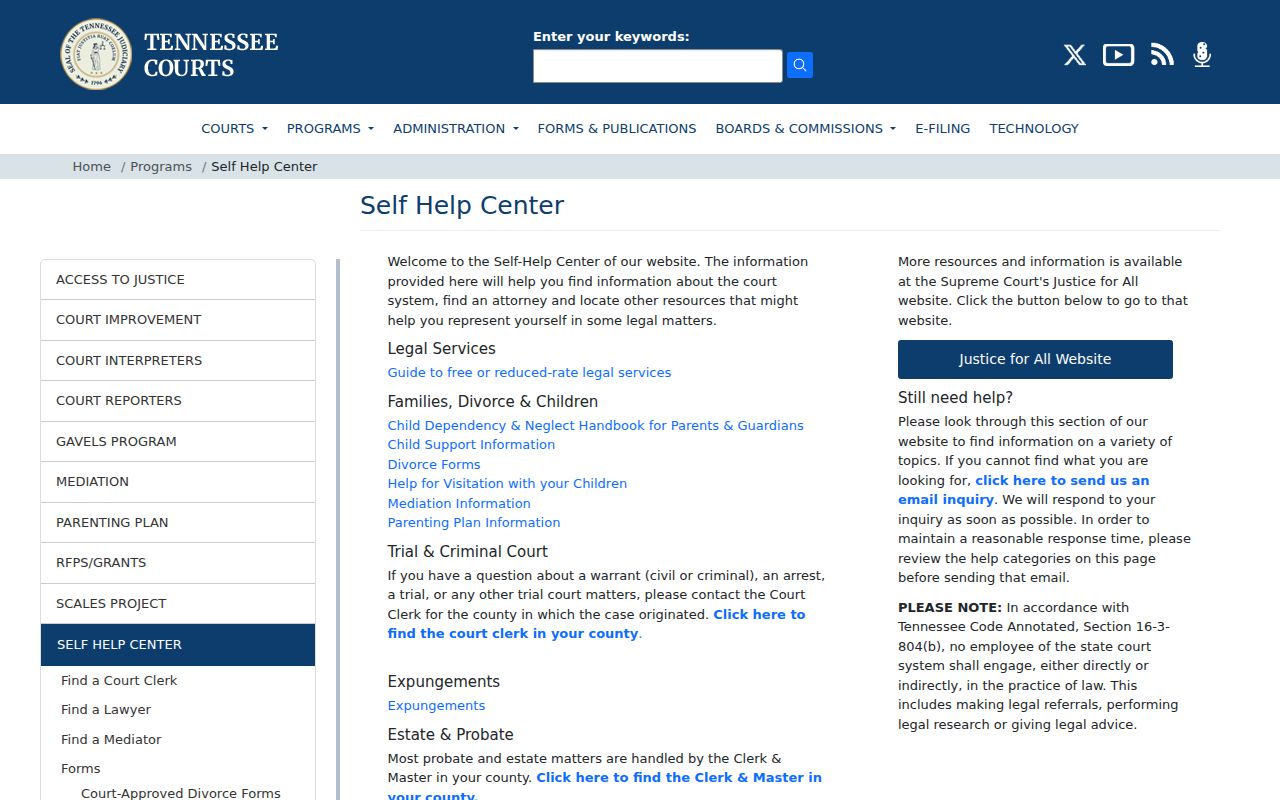
The captured self-help page gives Marshall County readers an official state route to forms while the clerk remains the source for the actual local file. For an expungement request, first obtain the docket and final disposition, then confirm with the clerk which court owns the record and which current form is accepted.
What a Criminal Case File Contains
A Marshall County court file centers on filed allegations and judicial action. It can connect the original agency and arrest tracking data to a later information or indictment, but the court charge may differ from the booking charge. Read at the count level. One count may end in a conviction while another is dismissed or resolved by nolle prosequi, which means the prosecutor formally chose not to continue that charge at that time.
| Case Number & Court | Identifies the docket, county, division, and court that owns the file. |
|---|---|
| Charging Document | Shows the complaint, information, or indictment and the Tennessee code cited for each count. |
| Docket Entries | Lists filings, hearings, motions, orders, and other events in date order. |
| Bond & Hearings | Records release terms, appearance dates, arraignment, and pretrial proceedings. |
| Disposition & Judgment | States the plea or verdict and outcome of each filed count. |
| Sentence & Financial Terms | Separates confinement, probation, costs, fines, and restitution where ordered. |
Public copies should omit protected identifiers. A case file can include counsel, filing and disposition dates, offense class, sentence structure, and chronological events. It is not a statewide rap sheet. The broader Marshall County criminal history overview explains how the clerk file differs from a TBI repository result.
Marshall County Case Outcome Terms
The final judgment is stronger evidence than a bare portal label. A dismissal ends a charge without conviction. An acquittal is a not-guilty result. Nolle prosequi records a prosecutor's decision not to continue at that point. A plea is the defendant's formal response, and a conviction is the judgment of guilt after a plea or verdict. Judicial diversion defers judgment while statutory conditions are completed and can create a later path to expungement.
Do not read “bond,” “costs,” and “restitution” as the same field. Bond concerns release and appearance. Costs are court-assessed charges, while restitution is an ordered payment tied to qualifying loss. Likewise, probation is community supervision imposed by the court, while parole follows a period of incarceration. If a short index entry is unclear, order the signed judgment and any sentencing order instead of guessing.
Criminal Case Stages in Marshall County
A felony can begin with an arrest or citation and an initial appearance in General Sessions. Bond is addressed early. The preliminary stage may lead to grand-jury review in the 17th Judicial District, where a returned indictment moves the matter into the felony trial stream. Arraignment states the filed charges and takes a plea. Pretrial motions and discovery follow, then a plea or trial produces a judgment. Sentencing can occur with the judgment or at a later hearing. An appeal creates a separate appellate record.
Case flow: Charges Filed › Arraignment › Pretrial › Plea or Trial › Disposition › Sentencing
The filed charge may change between booking and indictment. Counts may also be amended or dismissed. That is why Marshall County court research should end with the judgment and count-level disposition, not with the charge first typed at jail intake.
Marshall County Court Access Rule
The Tennessee Public Records Act governs many agency records, but court files also follow judicial access rules. Tennessee Supreme Court Rule 34 addresses public access to court records and the protected data held by the judiciary. Open access does not mean every identifier or every proceeding is exposed without limits.
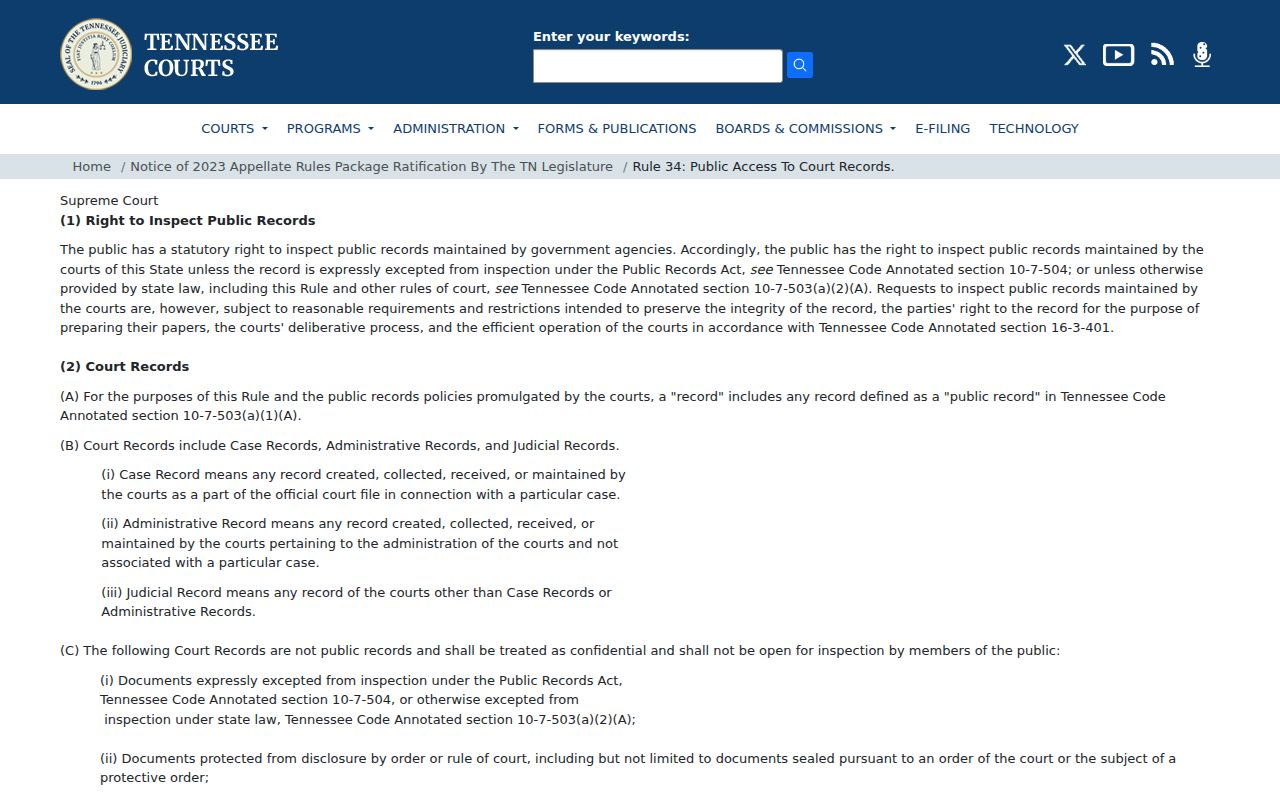
The Rule 34 capture marks the correct statewide authority for a Marshall County court-record request. Juvenile files, sealed or expunged material, protected victim and minor information, and personal identifiers can be closed or redacted. When a file does not appear in an index, ask the clerk whether the cause is a spelling issue, an archive location, a restricted case class, or a valid sealing order.
Federal Cases From Marshall County
Federal prosecutions do not become Marshall County clerk files merely because the conduct arose here. Marshall County is in the Columbia Division of the U.S. District Court for the Middle District of Tennessee. The Columbia courthouse is at 815 S. Garden Street, Columbia. District mail runs through 719 Church Street in Nashville. Federal dockets and filed documents use PACER after account registration, subject to the current federal fee schedule.
The PACER service is the official federal case-access channel.
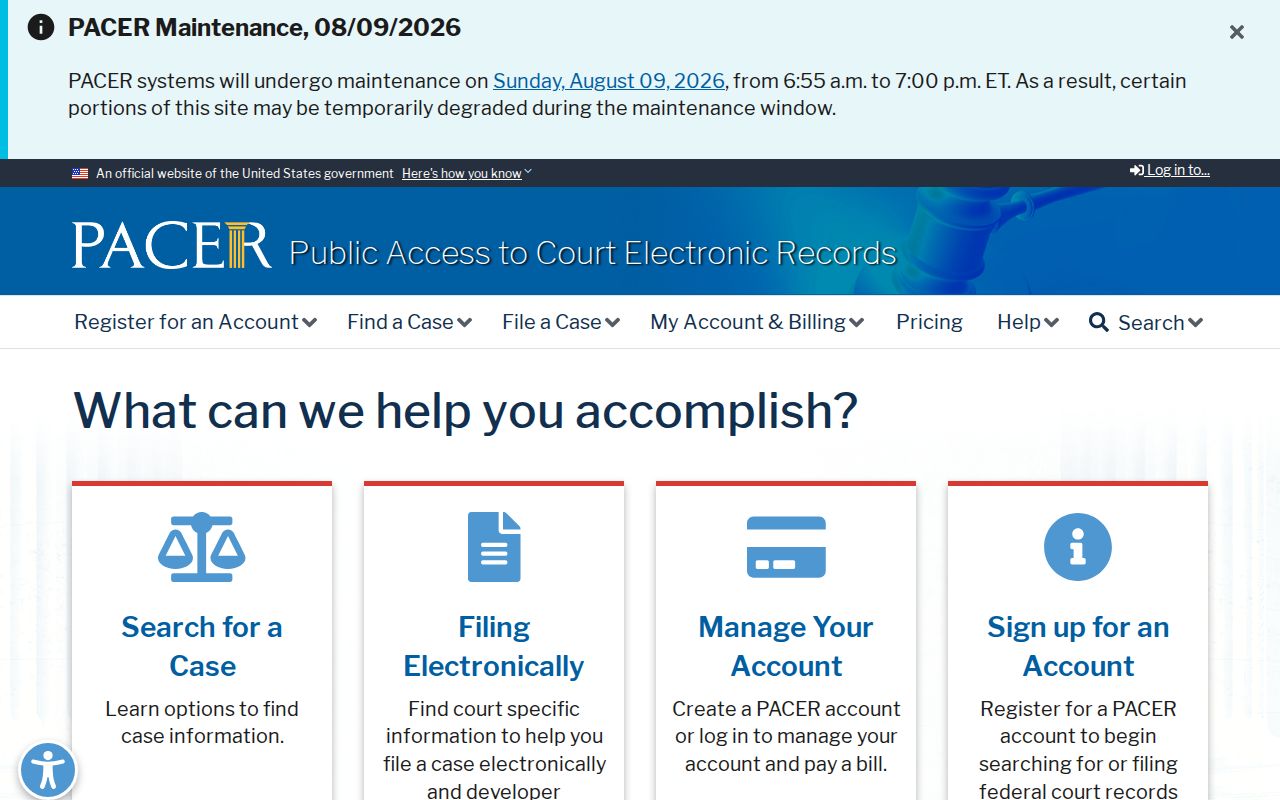
PACER searches federal parties and cases, not Tennessee trial-court dockets. Its August 2026 schedule lists ten cents per page, generally capped at three dollars per document, and waives a quarter's fees at thirty dollars or less. Readers should check the live schedule because PACER announced a temporary change for January 2027.
The Middle District of Tennessee website supplies district and courthouse information.
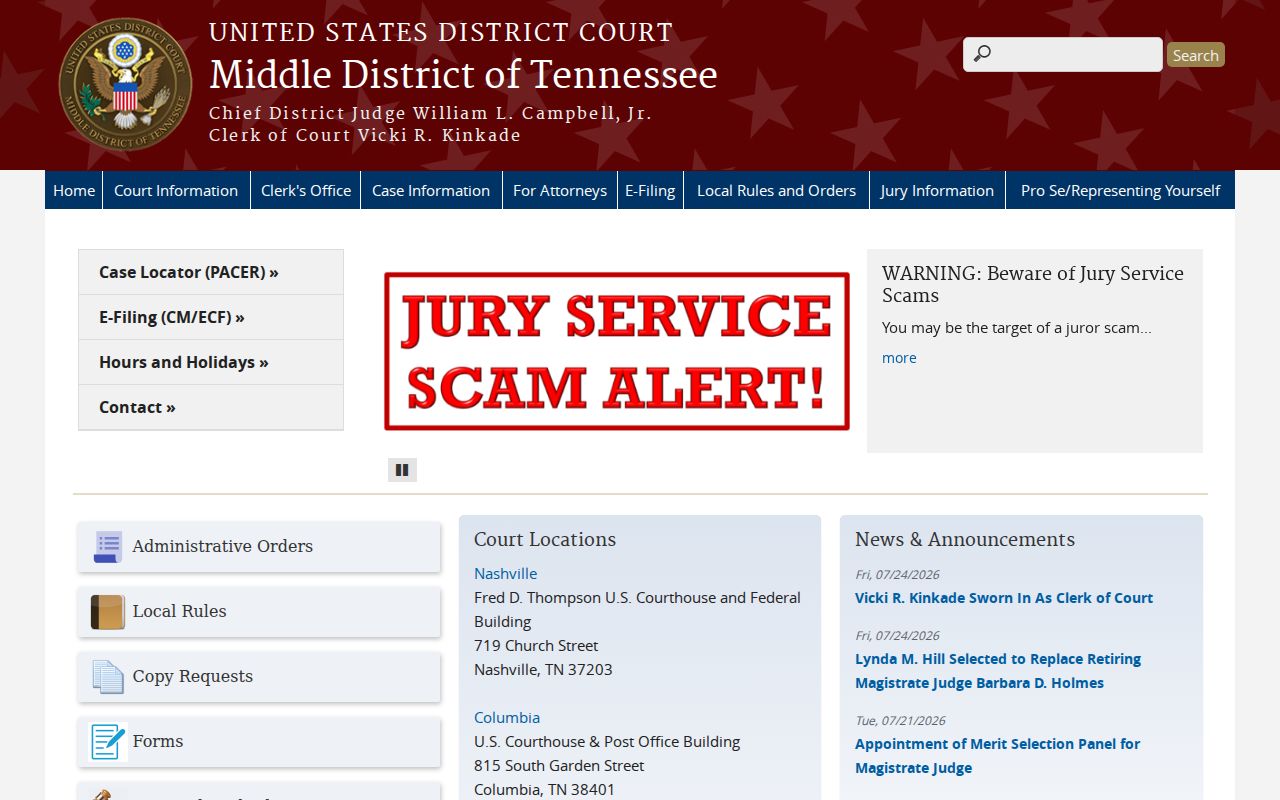
This district capture confirms the federal court layer that covers Marshall County. Use it for court locations and local federal rules, while PACER supplies the docket and filed federal documents.
Access Rules for Case Records
Marshall County court records are public when law and court rule permit, but access remains record-specific. The clerk's official page says Circuit and General Sessions material is available through diligent search, except for Juvenile records and other protected classes. Social Security numbers, financial-account data, protected victim details, minor information, and some full birth dates should not appear in a public copy. Active sealing or expungement orders can also change what the clerk may disclose.
A missing web result is not proof that no case exists. There is no official local public name-search portal to make that claim. Call the clerk, verify spelling and year, check the correct court stream, and ask about archives. If the inquiry began with an arrest, the Marshall County Arrest Search explains which agency report or booking record may exist before a prosecutor files a case.